
TS-7553-V2 Documentation Test V1
TEST ANCHOR PAGE
Test1 - This is a draft re-write. For now it is an experimental copy only that will evolve or get replaced. LT 12-1-25
| WARNING: | This is not the current latest manual for the TS-7553-V2, this is a page for testing new manual layouts. Please return to the TS-7553-V2 manual for the latest up to date manual! |
 | |
| Product Page | |
| Documentation | |
|---|---|
| Schematic | |
| Mechanical Drawing | |
| FTP Path | |
| Processor | |
| NXP i.MX6UL | |
| 528MHz or 696MHz Arm® Cortex®-A7 | |
| i.MX6UL Product Page |
Overview
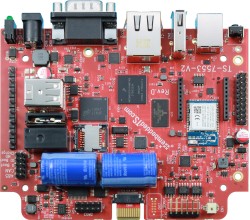
The TS-7553-V2 is a small embedded platform with an NXP i.MX6UL 696 MHz CPU with 512 MB DDR3 RAM. It is a spiritual successor to our TS-7553, using the same form factor and base features, but providing a more powerful CPU and many new features for overall better performance. The TS-7553-V2 can be ordered with soldered down WiFi with built in Bluetooth, our TS-SILO supercapacitor technology for safe shutdown upon power loss, non-volatile FRAM for 2 KiB of storage. There is also support for USB Gadget via the front USB B socket, an internal USB host port, support for our monochrome LCD and 4 button membrane keypad, and eMMC flash for a vast improvement over the TS-7553's NAND.
Getting Started
A Linux workstation is recommended and assumed for development using this documentation. For users in Windows or OSX, we recommend virtualizing Linux. Most of our platforms run Debian, which is recommended for ease of use if there is no personal distribution preference.
Virtualization
Suggested Linux Distributions
Development using a Windows or OSX system may be possible but is not supported. Development will include accessing drives formatted for Linux and often Linux-based tools.
Hardware Manual
The Hardware Manual is located TS-7553-V2 Hardware Manual
Software Manual
The Software Manual is located here: TS-7553-V2 Software Manual
Backup / Restore
While all of our products ship with images pre-loaded in to any supplied media, there are many situations where new images may need to be written. For example, to restore a device to its factory settings or apply a customized image/filesystem for application deployment. Additionally, specific units may be used for development and that unit's disk images need to be replicated to other units to be deployed in the field.
We offer a number of different ways to accomplish both capturing images to be written to other units, and the actual writing process itself. See the sections below for details on our USB Image Replicator tool to capture and/or write images, as well as details on manual processes to capture and write images on each of this device's media.
Software Images
Stock Images
| Revision | Changes |
|---|---|
| ts7553-V2-B-feb102017-prelim.tar.bz2 | Initial image compatible with the Rev B PCB |
| ts7553-V2-B-mar162017-prelim.tar.bz2 |
|
| ts7553-V2-B-may012017-prelim.tar.bz2 |
|
| ts7553-V2-B-jul202017-prelim.tar.bz2 |
|
| ts7553-V2-oct182017-prelim.tar.bz2 |
|
| ts7553-V2-dec152017.tar.bz2 |
|
| ts7553-V2-aug162021.tar.bz2 |
|
Linux 4.9.y Images
| Revision | Changes |
|---|---|
| ts7553-V2-linux4.9-20190402.tar.bz2 |
|
| ts7553-V2-linux4.9-20210817.tar.bz2 |
|
Linux LTS Images
| Image File | Changelog | Known Issues |
|---|---|---|
| ts7553v2-debian-bookworm-headless-20240904.tar.xz md5 |
| |
| ts7553v2-debian-12-bookworm-headless-20250711.tar.xz md5 |
|
U-Boot
| Revision | Changes |
|---|---|
| February 16, 2017 | Initial release for PCB Rev. B |
| April 5, 2017 |
|
| April 24, 2017 |
|
| October 16, 2017 |
|
| December 15, 2017 |
|
| January 15, 2018 |
|
| November 13, 2019 |
|
Product Change Notices
New eMMC chip
Due to an EOL on the older Micron MTFC4GMDEA-4M IT part, the replacement Micron MTFC4GACAJCN-4M IT has been qualified for use on this board. This new eMMC flash includes write reliability enabled by default. This will improve reliability for power loss events without requiring user intervention.
This updated part also has a larger erase block size which will require an updated production processes for those using the "emmc_reliability" script. This new chipset will require the latest version including this patch to function correctly.
Errata
Microcontroller Sleep at 5 VDC Input
- Description
- At 5 VDC input range to the TS-7553-V2, sleep modes of the microcontroller may be unreliable. The symptom is an immediate reboot after the sleep command is issued (instead of sleeping for the specified time and then turning back on), with the microcontroller reporting a
poweronreboot source fromtsmicroctl -iinstead of the correctsleepreboot source.
- Projected Impact
- This can cause applications relying on sleep modes to not correctly sleep and instead immediately reboot.
- Workaround
- The 8-28 VDC input range is not affected by this issue. Sleep will always perform as expected when running in this higher input voltage range.
- Proposed Solution
- No fix scheduled.
FCC Advisory
This equipment generates, uses, and can radiate radio frequency energy and if not installed and used properly (that is, in strict accordance with the manufacturer's instructions), may cause interference to radio and television reception. It has been type tested and found to comply with the limits for a Class A digital device in accordance with the specifications in Part 15 of FCC Rules, which are designed to provide reasonable protection against such interference when operated in a commercial environment. Operation of this equipment in a residential area is likely to cause interference, in which case the owner will be required to correct the interference at his own expense.
If this equipment does cause interference, which can be determined by turning the unit on and off, the user is encouraged to try the following measures to correct the interference:
Reorient the receiving antenna. Relocate the unit with respect to the receiver. Plug the unit into a different outlet so that the unit and receiver are on different branch circuits. Ensure that mounting screws and connector attachment screws are tightly secured. Ensure that good quality, shielded, and grounded cables are used for all data communications. If necessary, the user should consult the dealer or an experienced radio/television technician for additional suggestions. The following booklets prepared by the Federal Communications Commission (FCC) may also prove helpful:
How to Identify and Resolve Radio-TV Interference Problems (Stock No. 004-000-000345-4) Interface Handbook (Stock No. 004-000-004505-7) These booklets may be purchased from the Superintendent of Documents, U.S. Government Printing Office, Washington, DC 20402.
Limited Warranty
See our Terms and Conditions for more details.
| WARNING: | Writing ANY of the CPU's one-time-programmable (OTP) registers will immediately void ALL of our return policies and replacement warranties. This includes but is not limited to: the 45-day full money back evaluation period; any returns outside of the 45-day evaluation period; warranty returns within the 1 year warranty period that would require SBC replacement. Our 1 year limited warranty still applies, however it is at our discretion to decide if the SBC can be repaired, no warranty replacements will be provided if the OTP registers have been written. |
| WARNING: | Setting any of the eMMC's write-once registers (e.g. enabling enhanced area and/or write reliability) will immediately void ALL of our return policies and replacement warranties. This includes but is not limited to: the 45-day full money back evaluation period; any returns outside of the 45-day evaluation period; warranty returns within the 1 year warranty period that would require SBC replacement. Our 1 year limited warranty still applies, however it is at our discretion to decide if the SBC can be repaired, no warranty replacements will be provided if the OTP registers have been written. |
Trademarks
Arm and Cortex are registered trademarks of Arm Limited (or its subsidiaries) in the US and/or elsewhere.